Zelensky says US negotiators raised Donbas withdrawal in exchange for NATO membership
Ukrainian President Volodymyr Zelensky said US negotiators asked for the first time whether Ukraine would withdraw from the parts of the Donbas it still holds if it joined NATO. He repeated that Ukraine would not cede territory, but said a confirmed package of security guarantees could be put to a referendum. The White House had not commented at the time of publication.
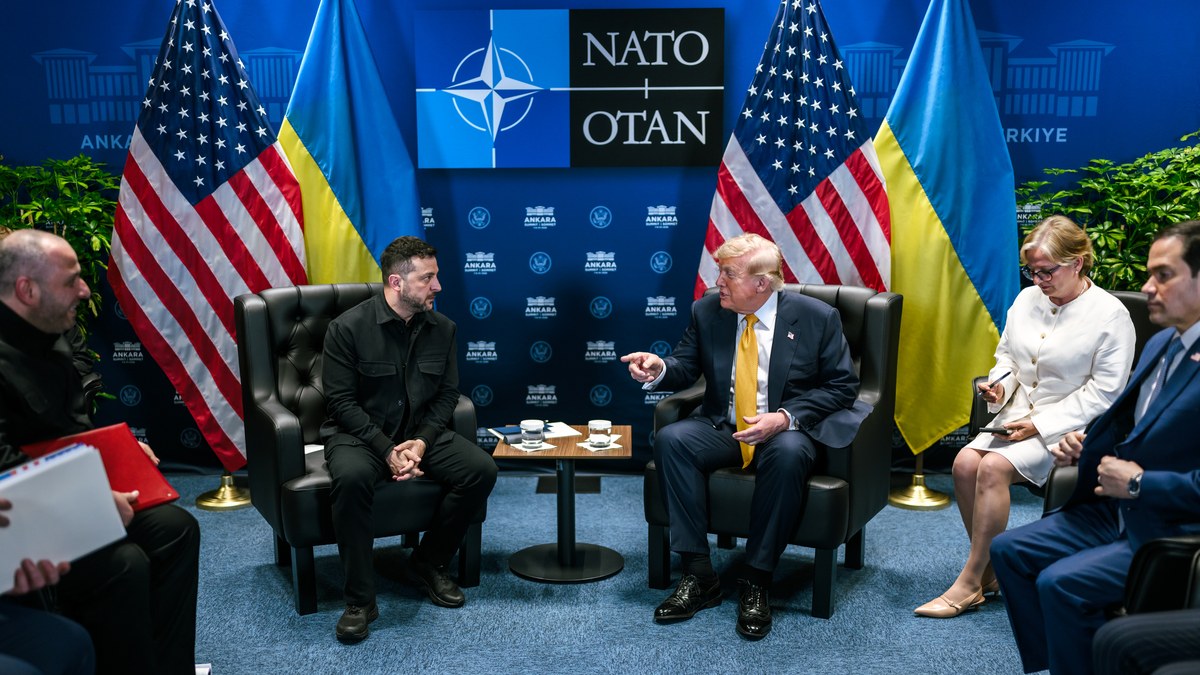
Ukrainian President Volodymyr Zelensky said US negotiators had asked, for the first time, whether Ukraine would withdraw from the parts of the eastern Donbas region it still holds in exchange for membership of NATO. The remarks were made to reporters on Friday, 13 November, and released by his office on Saturday, according to the BBC, Reuters, AP and Cadena SER.
"The Americans raised a question: 'What if Ukraine joins NATO? Would Ukraine withdraw from Donbas?' This was the first time this had been raised," Zelensky said, in comments reported by the BBC, Reuters and Politico. The White House and the US State Department did not immediately respond to a request for comment, Politico reported. AFP said NATO and Washington had not yet commented. The account is Zelensky's; US officials had not confirmed a formal offer at the time of publication.
The comments came after US President Donald Trump's envoys, Jared Kushner and Steve Witkoff, met Zelensky in Dublin on Thursday, following talks with Russian President Vladimir Putin in Moscow, the BBC reported. That followed two days of US-brokered talks between Ukraine and Russia in Abu Dhabi, which ended on Wednesday without a peace agreement, though the sides agreed a large prisoner exchange, Reuters reported.
"I have said repeatedly: Ukraine is not retreating and is not giving up its land to terrorists," Zelensky told reporters, according to Politico. Russia occupies most of the Donetsk and Luhansk regions that make up the Donbas, and about a fifth of Ukraine's territory overall, the BBC reported. Giving up the remaining parts of the Donbas still held by Kyiv would be symbolically significant for Ukraine, the BBC said.
Zelensky said Ukraine was discussing with partners a comprehensive security package that would include specific guarantees from NATO and the EU, a strong Ukrainian army with adequate troops, weapons and financial support for a set period, and a recovery plan with clear funding, according to Politico, Cadena SER and Reuters. "If the American side confirms precisely this to us, together with other NATO partners, then I will ask our Ukrainian society what it thinks: do we accept it or not? I have no right to make that decision on my own," he said, as reported by Politico. The BBC and Reuters said he would put such a proposal to a referendum. "Of course, this would be without any recognition of the occupied territories as Russian," he added, according to Politico. "But we need specifics, and we don't have them yet. All of this is still under discussion."
Zelensky said the US question made him believe that "NATO is back on the agenda," but cautioned: "You have also heard Putin's signals, and this is an extremely difficult conversation," the BBC and Reuters reported. Putin has long described Ukrainian membership of NATO as a red line for Moscow, citing it as one of the reasons for Russia's full-scale invasion in 2022, Reuters reported. Moscow has previously demanded territorial concessions, limits on the size of Ukraine's military and guaranteed neutrality as conditions of a peace deal; Ukraine has rejected those terms, the BBC reported.
Zelensky also warned that a new European security framework raised by the United States could be used by Moscow to weaken NATO and reshape Europe's borders, AP reported. "In my view, this can be dangerous," he told reporters, according to AP. "Real security in Europe means the EU and NATO. That's it. There is no other security in Europe," he said, according to Reuters. Cadena SER reported that he rejected anchoring a neutral status for Ukraine in the constitution, arguing that Ukraine is already outside NATO and asking what would then protect its long-term security.
Sources: Cadena SER, BBC, AP, Reuters, Politico, AFP.