Quad leaders in Manila issue joint statement on maritime corridors, cyber and AI
The leaders of the United States, Australia, India and Japan issued a joint statement in Manila on 17 November 2026 after their first Quad summit in two years. The official text opposes unilateral attempts to change the status quo by force or coercion, expresses grave concerns about economic coercion, and commits the four countries to open, safe and resilient maritime corridors in the Indo-Pacific. It also announces a business leaders' forum in early 2027, a first Quad maritime patrol-aircraft exercise in 2027, and enhanced cybersecurity cooperation.
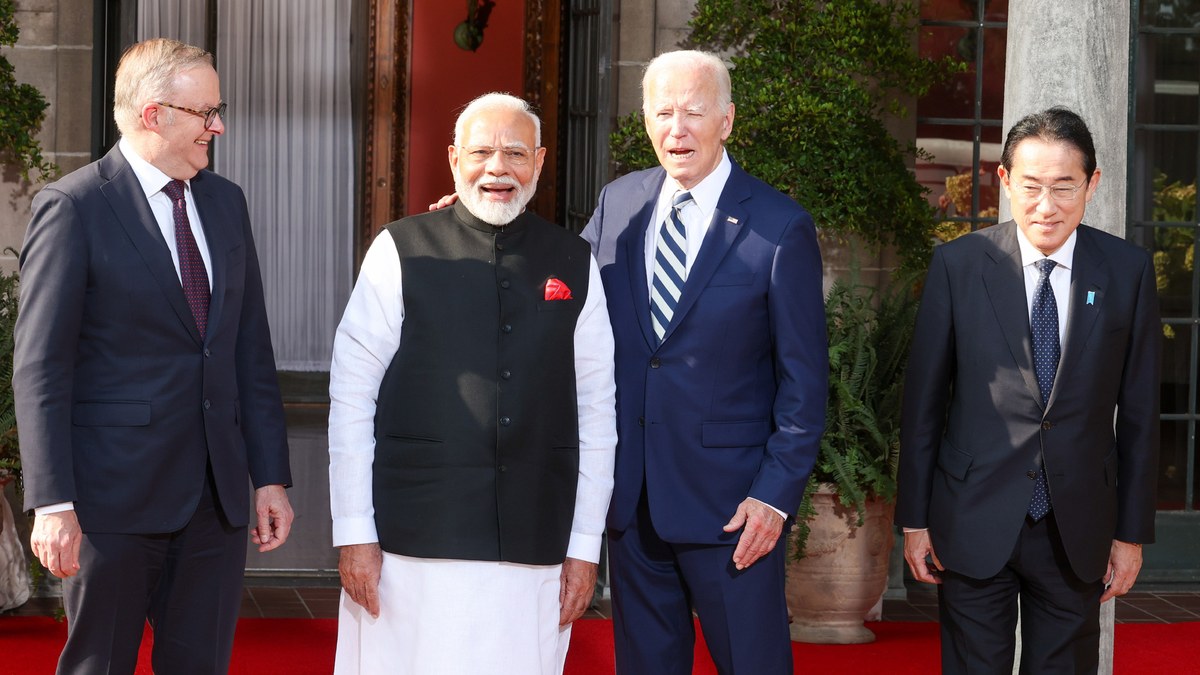
The leaders of the Quad, the informal partnership of Australia, India, Japan and the United States, met in Manila on Tuesday, 17 November 2026, on the sidelines of the Association of Southeast Asian Nations (ASEAN) summit hosted by the Philippines. US President Donald Trump, Indian Prime Minister Narendra Modi, Japanese Prime Minister Sanae Takaichi and Australian Prime Minister Anthony Albanese gathered for their first leaders' meeting since September 2024, Kyodo News reported. According to The Hindu, it is also the first Quad summit ever held in a country that is not a member of the group.
The meeting is the first at leaders' level of Trump's second term, which began in January 2025, and the first for Takaichi as Japan's prime minister. It comes two days before Trump travels to Shenzhen, in southern China, for what has been billed as the first-ever three-way summit between the United States, China and Russia, alongside bilateral talks with Chinese President Xi Jinping, on the fringes of the Asia-Pacific Economic Cooperation (APEC) forum, Kyodo said. We covered the plans in our earlier report, Trump, Xi and Putin to meet in Shenzhen for historic trilateral summit.
In opening remarks, Modi called the Quad "a constructive and trusted partnership" for India. "From maritime security to trusted supply chains, new technology to disaster response, it has been our endeavour that Quad provides trusted solutions for the entire Indo-Pacific," he said, according to India Today. Modi noted that the four countries' foreign ministers had met five times since January 2025, which he described as proof of "political will and shared commitment", and said he was confident the meeting would "set concrete goals for the next phase of our cooperation".
Modi also pointed to the city's symbolism. Officials from the four countries first met in Manila in 2007, he recalled, and it was again in Manila, ten years later in 2017, that the dialogue was restarted. Holding a leaders' meeting there now was "an important milestone", he said.
Takaichi, attending her first Quad leaders' meeting, thanked Trump for his efforts and said the group would "shape the future of the Indo-Pacific together with our regional partners" by strengthening the resilience of countries in the region in maritime security, economic security, energy and critical and emerging technologies, according to remarks reported by ANI and carried by Devdiscourse. Albanese said the talks would cover critical minerals and rare earths, artificial intelligence and maritime security, and that it was "appropriate" to meet in Manila because all four countries are ASEAN partners. He also welcomed a Quad business leaders' meeting planned for 2027 as a "practical initiative" for the private sector.
Trump, during the family photo, called Modi "a very tough man" and joked that Takaichi was "even tougher", Firstpost reported. Indian weekly The Week quoted him as saying the Quad would launch a new AI accelerator and hold an exercise featuring maritime patrol aircraft, and that the four countries would have "everything that we need" in rare earths "in 10 months". These are the president's own claims; no detailed timetable for the rare-earth goal was published.
After the talks, the four governments published a Quad Leaders' Summit Joint Press Release, dated 17 November 2026 and also issued by the Prime Minister's Office of Japan and by the Australian government. The official text says the grouping is "a force for good and a partnership of action, committed to peace, stability, and prosperity." The leaders said they "strongly oppose any destabilizing or unilateral actions that seek to change the status quo, including by force or coercion, which escalate tensions and undermine regional peace and stability." They also expressed "grave concerns about economic coercion, including through arbitrary export restrictions," and committed "to work together to ensure open, safe, and resilient maritime transit corridors in the Indo-Pacific."
The joint statement announced several practical steps. The inaugural Quad Business Leaders' Forum is scheduled for early 2027, bringing together business leaders, government officials and policy experts from the four countries. The leaders welcomed the Indo-Pacific Maritime Surveillance Collaboration, described as a new initiative to enhance information sharing and maritime domain awareness, and said that in 2027 their P-8 and P-3C patrol aircraft are scheduled to fly in a maritime exercise for the first time in a Quad context. They also announced "enhanced Quad Cybersecurity Cooperation," citing a rapid increase in the number and scale of cyber incidents in the region, and they affirmed a Super Intelligence Accelerator, previously announced by their foreign ministers in Atlanta, which is intended to coordinate and fund trusted "Super Intelligence" access, deployment and technical assistance across the Indo-Pacific — the term used in the official text. The statement also recorded progress under the Quad Partnership for Cable Connectivity and Resilience, including an expansion of Australia's contribution to focus on electricity cables, and upcoming undersea cable projects in the Indian Ocean. The four leaders "unequivocally" condemned terrorism in all its forms, including cross-border terrorism.
Japan's official summary of the meeting, published by the Prime Minister's Office, said the talks in Manila began at 6:45 p.m. local time (12:45 in Romania) and lasted about 90 minutes. It said the four leaders aligned their views on the situation in the Indo-Pacific, including in the East China Sea and the South China Sea, and expressed strong opposition to any unilateral attempts to change the status quo by force or coercion. They also discussed the situation in the Middle East, including around Iran, and agreed on the importance of free and safe navigation and of energy security, the Japanese summary said.
The Quad traces its roots to the four countries' joint relief effort after the 2004 Indian Ocean tsunami. It was elevated to foreign-minister level in 2019, during Trump's first term, and to leaders' level in 2021 under President Joe Biden, Kyodo noted. The last leaders' summit was hosted by Biden in his hometown of Wilmington, Delaware, on 21 September 2024.
India, which holds the rotating chair, was due to host the next summit in 2025, but the meeting did not take place amid uncertainty over a Trump visit, India Today reported. The Hindu said New Delhi is reluctant to hand over the chair without first hosting a summit, and that a meeting in Delhi next year remains possible. Firstpost argued that Trump has given the grouping less priority than Biden did, which is why the leaders met on the margins of another summit rather than at a stand-alone event. Work at lower levels continued: at their meeting in Atlanta last month, Quad foreign ministers voiced "grave concerns" over "economic coercion, including through arbitrary export restrictions", Kyodo reported, in an apparent reference to China.
The meeting tests whether the Quad still carries weight as Washington prepares for high-stakes talks with Beijing and Moscow. Kyodo reported that Tokyo is worried Trump could take a more conciliatory line towards China and Russia, and Japan is itself facing Chinese export restrictions on rare earths after Takaichi's remarks on Taiwan last year. China controls more than 90 percent of global refining of several critical minerals, including rare earths, graphite and gallium, ABC News (Australia) noted. Shipping security is another priority: The Hindu, citing a Reuters briefing, said attacks on commercial vessels were likely to be raised, noting that at least 30 Indian seafarers have been killed in attacks linked to the conflicts involving Iran and Ukraine.
Attention now turns to Shenzhen, where Trump is due to meet Xi Jinping and Vladimir Putin on Thursday, 19 November, after a stop in Manila. We have a separate report on those plans, which has been updated as Xi and Putin began their own talks on 18 November: Xi and Putin meet in Shenzhen as Trump leaves Manila for Thursday's trilateral summit. Whether India finally hosts a Quad summit in 2026 or later, and what the 2027 business leaders' forum and the planned maritime patrol flights deliver, will show whether the commitments set out in the Manila statement produce concrete results.
Sources: Quad Leaders' Summit Joint Press Release, The White House, 17 November 2026; Japan-Australia-India-U.S. (Quad) Leaders' Summit (Summary), Prime Minister's Office of Japan, 17 November 2026; remarks by Prime Minister Narendra Modi, 17 November 2026, via India Today and The Week; remarks by Sanae Takaichi and Anthony Albanese via ANI/Devdiscourse; Kyodo News, 17 November 2026; Firstpost, 17 November 2026; The Hindu, 17 November 2026; ABC News (Australia), 17 November 2026.