Spain holds first general strike in 14 years over housing, wages and prices
Spain’s first general strike in 14 years began on Wednesday, 11 November 2026, after CCOO and UGT called a 24-hour walkout over wages, housing and prices, 18 days before a snap election.
Spain’s first general strike in 14 years began at midnight on Wednesday, 11 November 2026, after the country’s two largest unions, CCOO and UGT, called a 24-hour walkout under the slogan “wages, housing, prices.” Other unions, including CGT, CNT and the Confederation of Tenants’ Unions, also backed the action, El País reported. EFE said the strike runs from 00:00 to 24:00, with adjustments for shift work, and that workers in Ceuta were left out of the call because of the city’s migration emergency. The walkout is the first nationwide general strike since 2012 and comes 18 days before a snap general election on 29 November, and two days before the campaign begins.
The Transport Ministry set reduced minimum services: about 73% of Renfe high-speed and long-distance trains, with similar shares for Iryo and Ouigo, 75% of Cercanías commuter trains at peak hours and 50% otherwise, and between 18% and 85% of scheduled flights depending on the route, El País reported. Metro de Madrid said 79% of trains were running at the morning peak, above the region’s minimum, and that ridership was 21% lower than on the previous Wednesday. CCOO said electricity demand in the first hours was 9.7% lower than in the same period a day earlier. The unions also reported strong early stoppages at car plants, including Volkswagen Navarra and Seat Barcelona, and at the ports of Algeciras and Valencia; those participation figures have not been independently confirmed.
Pickets blocked or slowed roads into Madrid, Valencia and several points in Catalonia, including access to Barcelona’s Sants station, according to El País, EFE and Catalonia’s traffic authority. Some cuts, including on Madrid’s A-5 and Valencia’s V-21, were later cleared by police. Unions denounced police charges at municipal bus depots in Madrid and at pickets in Andalusia. The National Police said one person was arrested and 22 identified after clashes in Logroño, El País reported. Main marches were due in the afternoon, including a demonstration from Atocha to Plaza de España in Madrid at 18:00.
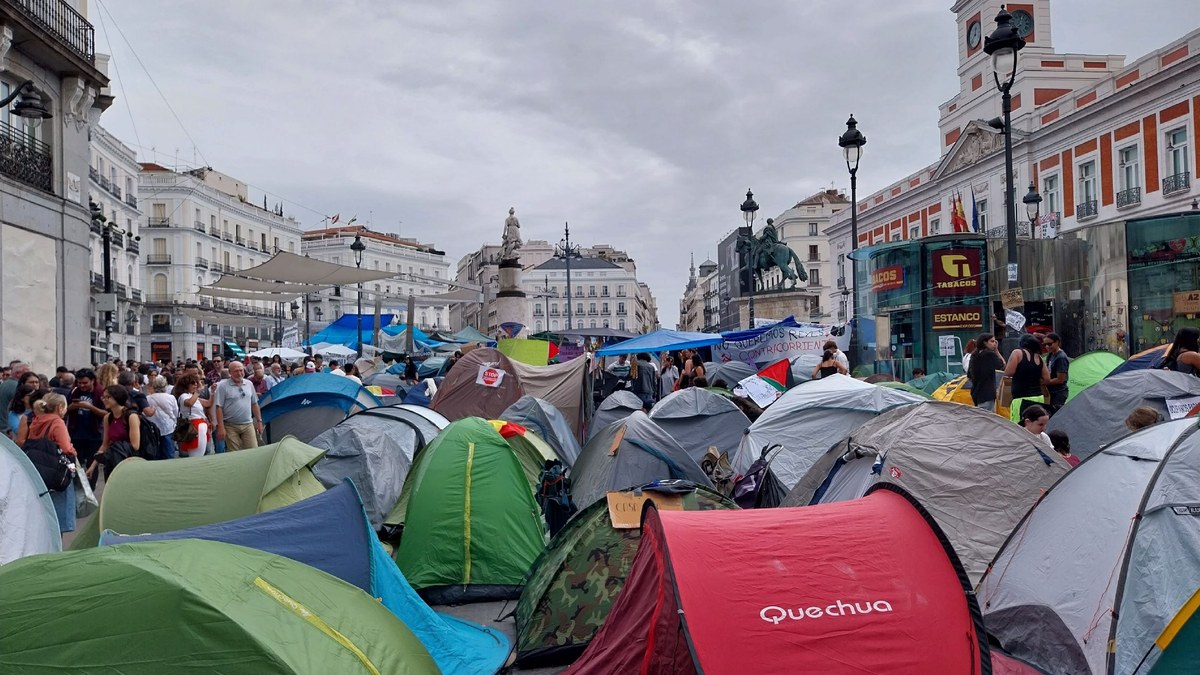
The strike follows months of housing protests, including a Puerta del Sol encampment after the eviction of 87-year-old María del Carmen Abascal in Madrid. The Bank of Spain has estimated a shortage of about 750,000 homes, which it says could exceed one million by 2028, Reuters and BBC News have reported. According to the Spanish Youth Council, average rents of €1,176 a month are close to a young worker’s average pay of €1,190. Prime Minister Pedro Sánchez’s government has backed the strike as a defence of rights. The conservative Popular Party and Vox have called it a political move against the opposition ahead of the vote; PP leader Alberto Núñez Feijóo said a strike “against the opposition” would be “a nonsense that does not exist in any country of the European Union,” BBC News reported. The employers’ group CEOE also criticised the call. Unions that did not join included CSIF, USO and Fetico, El País said.