Magnitude 6.7 earthquake strikes Peru’s Junín region, felt strongly in Lima
A magnitude 6.7 earthquake struck Peru’s Junín region on Friday evening, 20 November 2026, and was felt strongly in Lima and other regions. The USGS and Peru’s IGP both listed the shock as 6.7, with different depths. The navy said there was no tsunami, and first official reports confirmed no casualties.
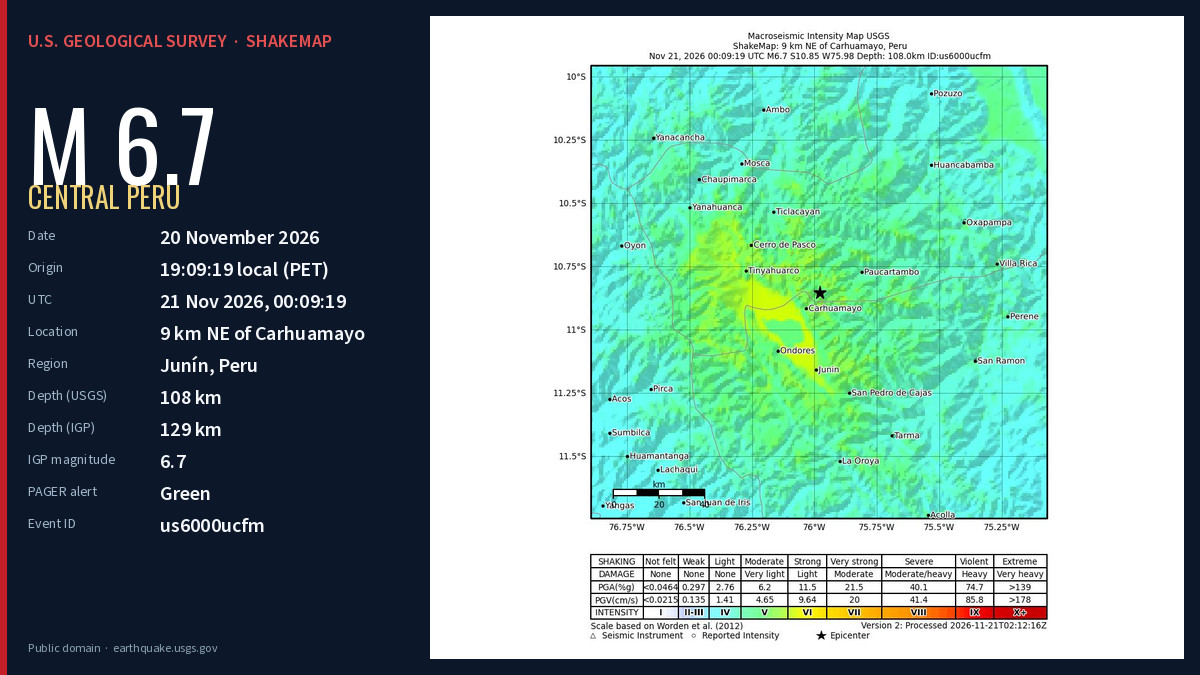
A magnitude 6.7 earthquake struck the highlands of central Peru on Friday evening, 20 November 2026, and was felt strongly in Lima and in several other regions. The United States Geological Survey said the quake occurred at 19:09:19 local time (00:09:19 UTC on 21 November), with an epicenter 9 kilometres north-east of Carhuamayo, in the Junín region, at a depth of about 108 kilometres. Peru’s Instituto Geofísico del Perú (IGP) recorded the same magnitude but placed the epicenter 30 kilometres north-west of Junín, at a depth of 129 kilometres. The Directorate of Hydrography and Navigation of the Peruvian Navy said the earthquake did not generate a tsunami on the Peruvian coast. In the first official reports, authorities had not confirmed any deaths or injuries.
The USGS listed the event as a reviewed moment-magnitude (Mww) 6.7 shock, with coordinates 10.8548 degrees south, 75.9779 degrees west, and a hypocentral depth of 108 kilometres. Its event page identifies the quake as us6000ucfm. About 99 people had submitted felt reports to the USGS “Did You Feel It?” system, with a community intensity around V on the modified Mercalli scale. The agency’s ShakeMap showed moderate shaking near the epicenter, around Carhuamayo, Ondores and the town of Junín, fading to lighter shaking across a wide area of the central Andes.
IGP, in report IGP/CENSIS/RS 2026-0818, put the magnitude at 6.7, the depth at 129 kilometres and the epicenter near 10.97 degrees south, 76.19 degrees west — about 30 kilometres north-west of Junín, in the province and region of the same name. The institute assigned an intensity of V in Junín. Those differences of location and depth between a national network and the USGS are common in the first hours and do not change the overall picture: a strong, intermediate-depth earthquake under the Andes. IGP president Hernando Tavera said the depth explained why the shaking was felt over a large area and why people described a long “train of waves,” rather than a short, sharp jolt. He said it was felt in Junín, Lima, Chimbote and Ica, according to Peruvian coverage of his remarks. Reports compiled by RPP, and in the national civil-defence bulletin, also listed Callao, Huánuco, Pasco, Áncash and La Libertad among the areas where people felt the quake. Diario Correo mentioned Cerro de Pasco and Huánuco as well.
Some early international notices put the magnitude at 6.8 or even 6.9. Those figures circulated before the main agencies finished their reviews. Both the USGS and IGP subsequently listed the earthquake as magnitude 6.7, and that is the figure used in official Peruvian bulletins.
Because the epicenter was inland, under the Andes, and the rupture was deep, a Pacific tsunami was not expected. Peru’s Dirección de Hidrografía y Navegación (DHN), part of the Navy, issued an official statement that the earthquake “does not generate a tsunami on the Peruvian coast.” La República, RPP and Andina all carried that confirmation. There was no coastal evacuation order tied to a tsunami threat.
In the first hours, no deaths or injuries were confirmed by official sources or by major news agencies. Andina reported that no injuries were known at the time of its dispatch. AP similarly said there were no immediate reports of casualties. That is a first-hours picture, not a final accounting for every remote community.
Damage reports were limited and local. INDECI chief Luis Vásquez, speaking to RPP later on Friday evening, said there had been no reports of significant damage in Junín so far, that remote areas were still being checked, and that some rock slides had been reported on roads, without traffic accidents. The National Emergency Operations Centre (COEN) was monitoring the situation overnight. INDECI’s seismic bulletin 818-2026 set out the official parameters from IGP. Diario Correo reported that Carhuamayo’s mayor, Abdel Vega, said at least seven dwellings had cracks in a preliminary count, and that many houses in the district are rustic; he called it the strongest quake in the district’s history. In Ondores, provincial mayor Elio Zevallos said corrals had fallen and that hundreds of people had left their homes, but he reported no human casualties and no major damage in the provincial capital.
In Lima, a rockfall from the Costa Verde cliffs after the earthquake was confirmed by both El Comercio and RPP. Earth and rocks came down the bluffs, raising a dust cloud, and stones passed through safety mesh onto the coastal roadway. Drivers moved away from the lane nearest the cliffs. Mario Casaretto, the Lima municipality’s disaster-risk manager, told El Comercio that retaining meshes had held back rocks that could have caused injuries, that there were no reports of victims at the site, and that the situation there was not critical. A driver, Roberto Ugarte, told RPP that stones fell onto the road as he was descending toward Magdalena and that traffic stopped. Casaretto also mentioned a lightweight roof that came down in San Borja. El Comercio reported a rockfall onto the roof of a house in Payet, in the district of Independencia, and further reports from Chaclacayo. In Huánuco, the regional emergency office told RPP that a rockfall had blocked the Carretera Central on the Huánuco–Ambo stretch at Tomayquichua.
The USGS Prompt Assessment of Global Earthquakes for Response (PAGER) system issued a green alert for the event, a model that indicates significant casualties and economic losses are not expected. That estimate is based on shaking, population and building stock; it is not a substitute for the ground reports still being gathered by INDECI and local governments.
Peru sits on one of the world’s most active plate boundaries, where the Nazca plate is subducting beneath the South American plate along the Peru-Chile Trench. That process produces both great shallow earthquakes on the coast and deeper events inside the descending slab. Friday’s shock belongs to the second group: an intermediate-depth earthquake, around 100 to 130 kilometres down. Quakes at that depth are often felt across a much wider area than a shallow event of the same magnitude, because the energy is released farther from the surface and travels farther, but they typically cause less intense shaking immediately above the epicenter than a comparable coastal quake. That is why a magnitude 6.7 event in Junín could rattle high-rises in Lima, more than 170 kilometres away, without matching the destruction of Peru’s great shallow earthquakes. The 15 August 2007 Pisco earthquake, a shallow magnitude 8.0 shock on the coast, killed hundreds of people and wrecked large parts of Pisco and Ica. The 31 May 1970 Ancash earthquake, also shallow, triggered a catastrophic debris avalanche from Huascarán and remains the deadliest disaster in Peru’s recorded history. Those events are a reminder of the country’s seismic risk; they are not a description of what happened on 20 November 2026.
Civil-defence officials said they would continue to check isolated areas overnight and asked the public to follow only official information on aftershocks and any further damage. At the time of writing, the confirmed picture was a widely felt intermediate-depth earthquake of magnitude 6.7, no tsunami, no confirmed casualties, and a cluster of local effects — cracked houses in Carhuamayo, fallen corrals in Ondores, and rockfalls on roads, including on Lima’s Costa Verde and on a stretch of the Carretera Central in Huánuco.
Sources: U.S. Geological Survey event us6000ucfm and ShakeMap; Instituto Geofísico del Perú (report IGP/CENSIS/RS 2026-0818) and IGP president Hernando Tavera, as reported by RPP and other Peruvian outlets; INDECI / COEN bulletin 818-2026 and INDECI chief Luis Vásquez, via RPP; Dirección de Hidrografía y Navegación of the Peruvian Navy, via La República, RPP and Andina; El Comercio; Diario Correo; Andina; Associated Press.