Magnitude 7.0 earthquake strikes remote northern Tibet, houses collapse in Baqen county
The shallow quake hit a sparsely populated high-altitude area. No casualties had been reported in the first hours, but power was cut and villages are still being checked.
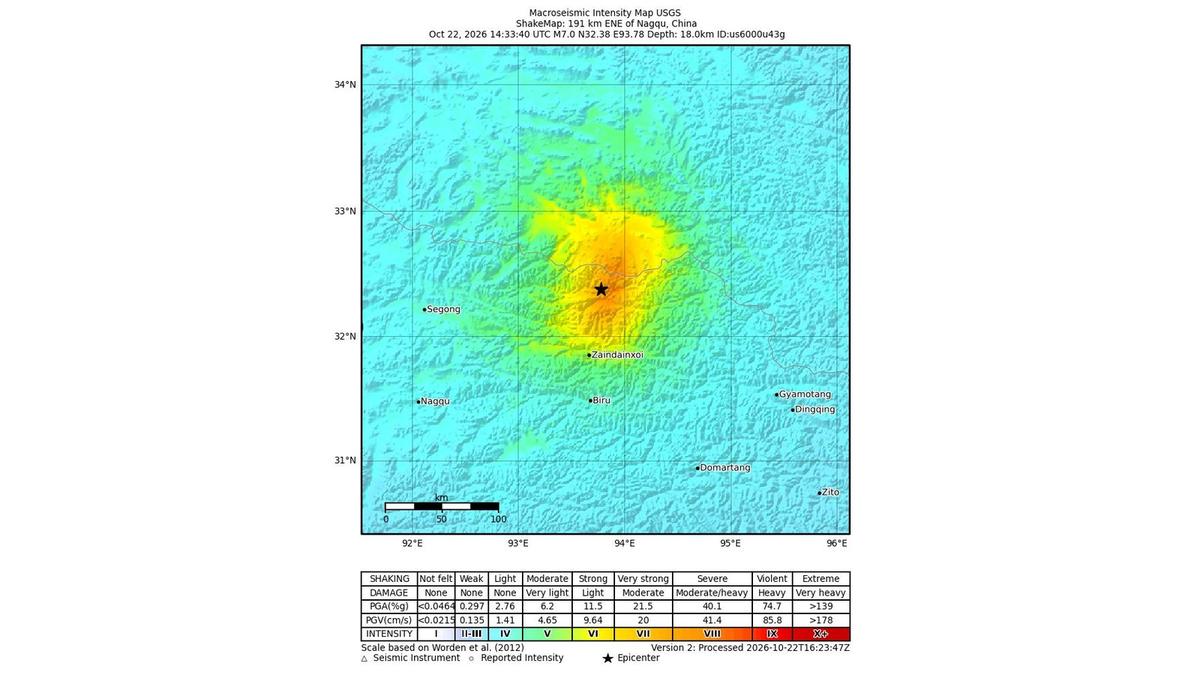
A magnitude 7.0 earthquake struck Baqen county in Nagqu, in China's Xizang (Tibet) Autonomous Region, at 10:33 p.m. Beijing time on Thursday (17:33 in Romania), the China Earthquake Networks Center (CENC) said. It put the epicentre at 32.40 degrees north and 93.79 degrees east, at a depth of 10 km. The US Geological Survey (USGS) and the European-Mediterranean Seismological Centre (EMSC) also measured it at magnitude 7.0. The USGS placed it 191 km east-northeast of the city of Nagqu, at a depth of 18 km.
The epicentre was in Maru township, about 70 km from the county seat, Xinhua reported. In the county seat the shaking was strong, power was cut and phone signal was poor. A deputy head of Maru township said walls of the township office building had cracked and some houses had collapsed, but no casualties or property losses had been reported at the township seat so far. Villages were still being checked.
Shaking was also strongly felt across the neighbouring city of Qamdo, where residents of high-rise buildings in the counties nearest the epicentre went outside and schools gathered pupils on sports grounds. Qamdo had received no reports of damage or casualties and sent 80 rescuers to check the area. The average altitude near the epicentre is about 4,800 metres and the area is sparsely populated. China's Ministry of Emergency Management launched a level-four national emergency response and sent a working group to the area, while the China Earthquake Administration started its own level-two emergency response, Xinhua reported.
The USGS issued an orange alert for economic losses, saying significant damage is likely, and a yellow alert for deaths, meaning some casualties are possible. It estimated that about 2,650 people were exposed to severe shaking and noted that many homes in the region are built of adobe or unreinforced brick, which is vulnerable to earthquakes. A magnitude 5.2 aftershock followed about 40 minutes later.