SpaceX calls off Super Heavy catch on Flight 15; booster explodes over the Gulf as Starship reaches orbit
SpaceX launched Starship Flight 15 from Starbase, Texas, on Friday, then called off the Super Heavy booster's planned tower catch and diverted it to the Gulf of Mexico, where it exploded, Reuters, Spaceflight Now and the Associated Press reported. The Starship upper stage reached orbit and deployed 26 Starlink V3 satellites, SpaceX said.
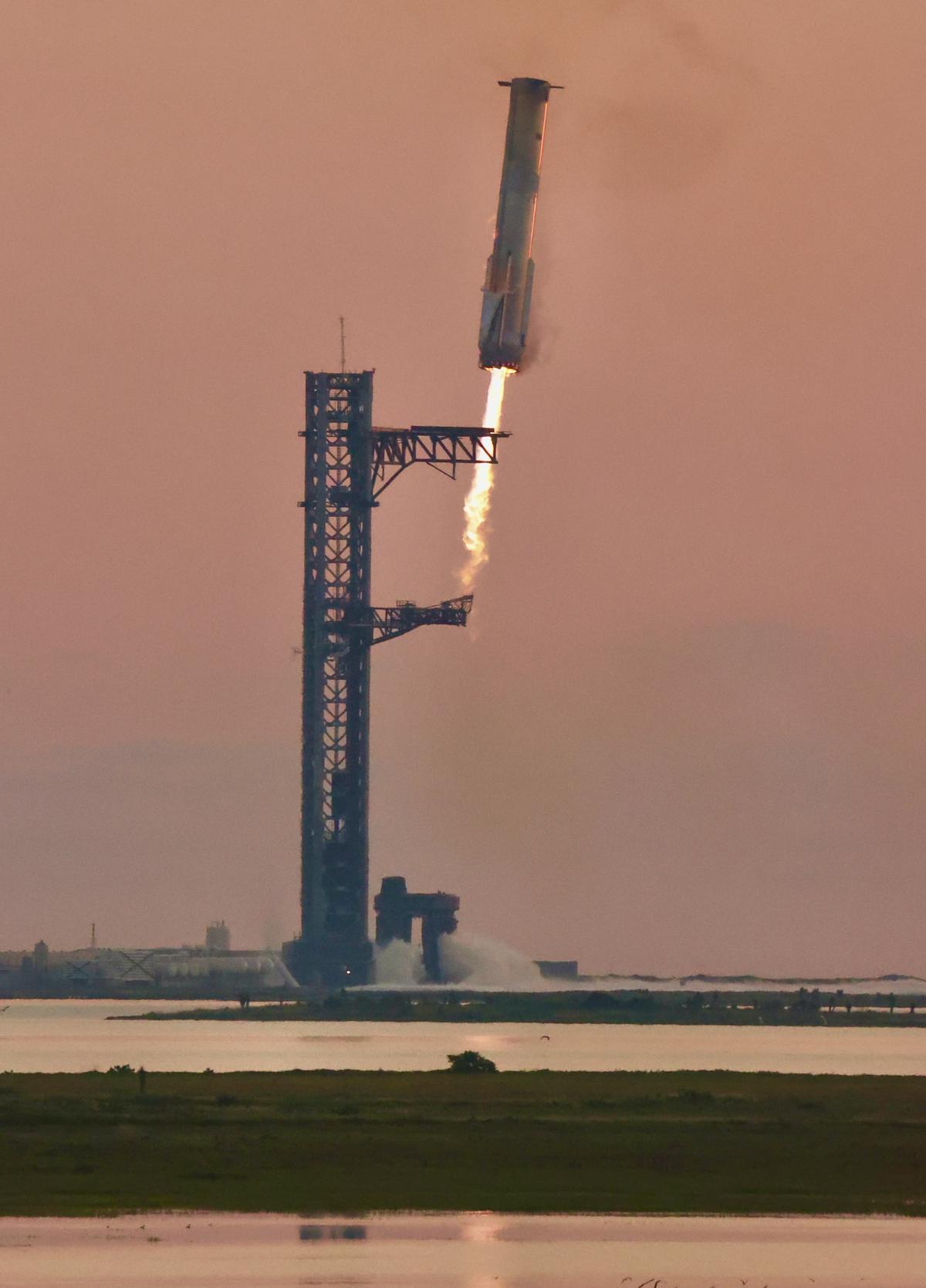
SpaceX launched the uncrewed Starship Flight 15 from Orbital Launch Pad 2 at Starbase, Texas, on Friday, 13 November 2026, at about 4:47 p.m. local time (22:47 UTC; 00:47 on Saturday, 14 November, Europe/Bucharest), Space.com reported, shortly after a 75-minute window opened at 4:45 p.m. CT, the company said. The flight was SpaceX's first attempt to recover both stages with the launch tower's mechanical arms, nicknamed "chopsticks." Super Heavy Booster 22, a Version 3 booster, was diverted from the planned tower catch and sent to an offshore splashdown in the Gulf of Mexico, SpaceX said. Reuters, Spaceflight Now and the Associated Press reported that the booster then exploded a short distance above, or as it reached, the water. The Starship upper stage, Ship 42, reached orbit and later deployed 26 Starlink V3 satellites, SpaceX said.
After a nominal ascent and hot-staging, SpaceX wrote on X that Super Heavy was "boosting back towards Starbase for a catch," then, minutes later: "Super Heavy has diverted to an offshore splashdown in the Gulf." The divert came about six and a half minutes after liftoff, around the time a catch had been planned, Space.com and Spaceflight Now reported. SpaceX did not immediately say why the catch was called off, Reuters and Space.com reported. A SpaceX spokesperson said during the webcast, "Safety is always the number one priority, and we're still testing out things that we haven't done before on these vehicles, and so we are prioritising making sure that we can perform each maneuver safely," BBC News reported. PBS News, citing the Associated Press, described an automatic abort after a booster malfunction; SpaceX itself did not use that wording. The company later posted photographs it captioned "Landing burn and splashdown for Super Heavy Booster 22." Reuters said the booster momentarily hovered before exploding a short distance over the sea surface. Spaceflight Now wrote that it exploded and disappeared from view before appearing to rise back out of the sea as remaining propellants burned off. There were no immediate reports of injuries or of damage on land. As of Saturday morning, 14 November 2026, the Federal Aviation Administration had not issued a public statement opening a mishap investigation into Flight 15.
Ship 42 reached orbit about 26 to 27 minutes after launch, at an altitude of about 275 kilometres (170 miles), SpaceX and Space.com said — only the second time a Starship has entered orbit, after Flight 14 on 28 September. "We've got a nominal orbit insertion, so Starship now in orbit around Earth for the second time ever. That's a really great moment," SpaceX presenter Dan Huot said on the webcast, according to Space.com. The company then wrote: "Starship is now deploying its payload of 26 Starlink V3 satellites. This deployment sequence will take ~42 minutes." It later confirmed: "Payload deploy complete. All 26 Starlink V3 satellites are in orbit." It was the second batch of operational V3 Starlinks launched on Starship, after Flight 14, Reuters and Space.com reported.
Flight 15 video:
SpaceX said teams would monitor the ship's systems during a long coast of about 21 hours and up to about 14 orbits, with early deorbit options available, but that "all systems are looking good right now." Several hours later it said "Starship and its heatshield are healthy" and that teams were still preparing for "a planned return to launch site catch at Starbase ~22.5 hours after launch," around 3:17 p.m. local time on Saturday (21:17 UTC; 23:17 Europe/Bucharest), Space.com reported. SpaceX has said the ship will return to the pad only if systems critical for reentry, the landing burn and the tower approach are healthy, with contingency splashdowns in the Pacific, off Hawaii and Chile, and in the Gulf of Mexico. A successful catch would be the first recovery of a Starship upper stage. Elon Musk wrote on X: "So far, so good for the ship," and later: "Starship is traveling around the world every ~90 minutes right now."
Three earlier Super Heavy boosters, all Version 1, were caught by the tower, and two of those were later reflown; Flight 15 was the first catch attempt for a Version 3 Super Heavy, SpaceX said. The last successful V1 tower catch was in March 2025, Reuters reported.
This report is based on SpaceX's Flight 15 webcast and posts on X, Space.com, Reuters, the Associated Press, Spaceflight Now, SpaceNews, BBC News and NBC News, and on statements by Elon Musk on X.
Watch our video reel on Facebook: Today News Brief reel