NASA's Voyager 1 will reach one light-day from Earth on 18 November
NASA said its Voyager 1 spacecraft will reach a distance of one light-day from Earth on Wednesday, 18 November 2026, more than 16 billion miles (25.9 billion kilometres) away. Voyager 1 is the most distant human-made object, the agency said, and a signal from Earth would take 24 hours to reach it.
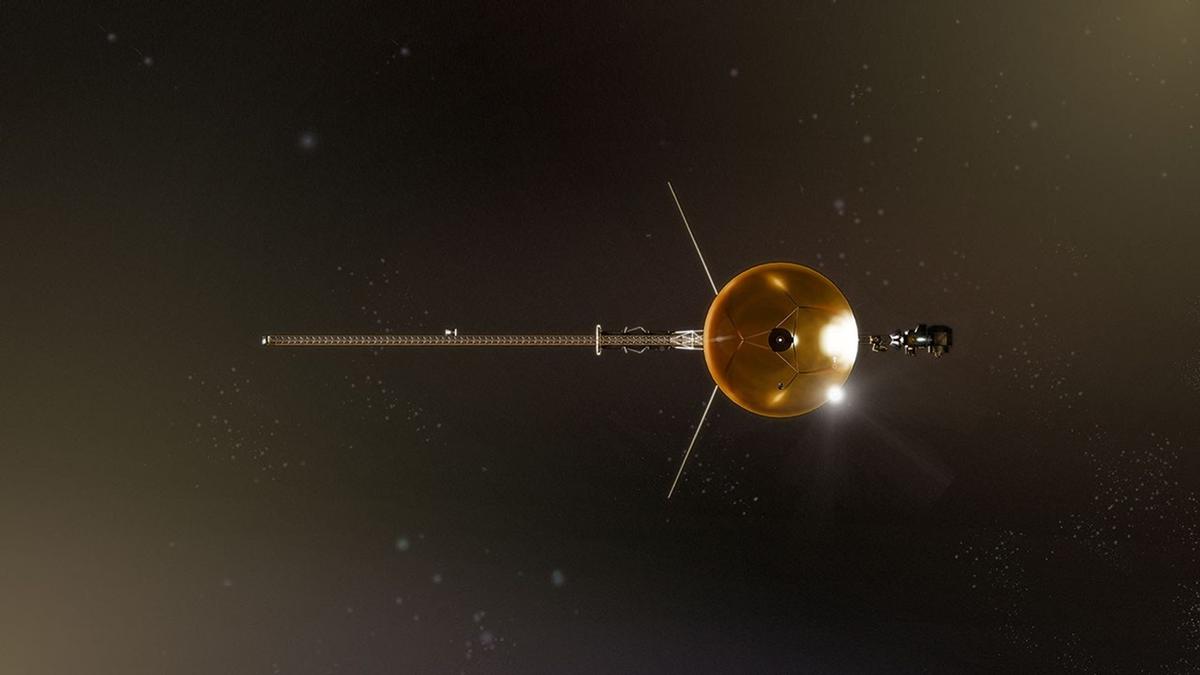
NASA said its Voyager 1 spacecraft will reach a distance of one light-day from Earth on Wednesday, 18 November 2026 — more than 16 billion miles, or 25.9 billion kilometres. Voyager 1 is the most distant human-made object, the agency said in a news release, and light or a radio signal from Earth would take 24 hours to reach the spacecraft.
A NASA Science briefing on the milestone gives the moment as 5:16:07 a.m. EST on 18 November (12:16:07, Romania time). NASA Science defines a light-day, the distance light travels in 24 hours, as 16,094,799,096 miles (25,902,068,356 kilometres). A related NASA Science page says that at that time Voyager 1 will be 16.094 billion miles (25.902 billion kilometres) from Earth. A reply from the spacecraft would take another 24 hours to return, so a two-way exchange would take two days.
Voyager 1 was launched on 5 September 1977 and, NASA Science said, will have taken 49 years, two months and 11 days to travel one light-day. It entered interstellar space in August 2012 and is travelling at nearly 38,000 mph (61,000 kph), according to the same NASA pages. Its twin, Voyager 2, launched on 20 August 1977 and entered interstellar space in 2018, is expected to reach one light-day from Earth in November 2035, NASA Science said.
NASA is marking the milestone with two events, the agency said in a news release updated on 13 November 2026. On Tuesday, 17 November, it is inviting the public to take part in "Shine Bright for Voyager's Light-Day," a symbolic wave of golden light after sunset, including a tool that can flash the spacecraft's call sign, VGR, in Morse code. On Thursday, 19 November, at 12 p.m. EST, NASA's Jet Propulsion Laboratory in California will host a discussion on the status of Voyager 1 and 2, to be streamed on NASA's live channel.
Sources: NASA news release (10 November 2026, updated 13 November 2026), NASA Science and the Associated Press.