Hubble spots a cosmic 'cat's tail' that could wrap around the Sun-Earth system 500 times
Astronomers using the Hubble Space Telescope studied a dark 'cat's tail' of dust around the young star Beta Pictoris and concluded it probably formed when two Pluto-sized bodies collided.
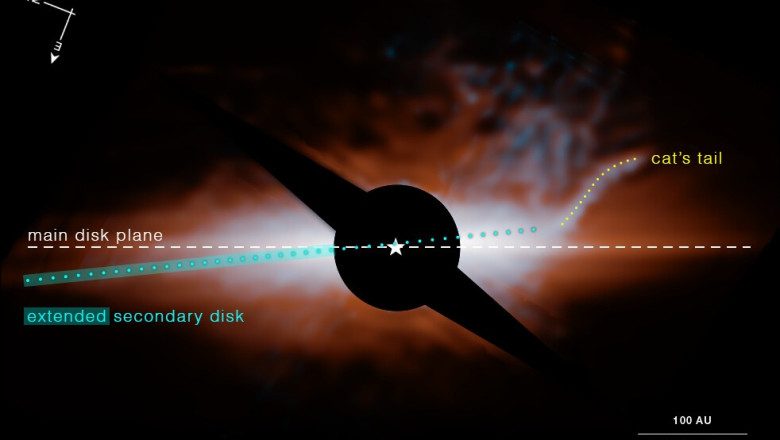
Astronomers using the Hubble Space Telescope have studied a structure nicknamed the 'cat's tail', which extends from the debris disc around Beta Pictoris, a young star about 63 light-years from Earth. The researchers concluded that it probably formed in a collision between two bodies the size of Pluto.
The structure is enormous: it could wrap around the Sun-Earth system about 500 times. Space.com, which reported the findings, calculated that its length equals about 200 trillion domestic cats placed end to end.
Until now, the tail had been seen only by the James Webb Space Telescope, which observes in infrared light. It had remained invisible at shorter wavelengths. The new work draws on 14 years of observations.
Team leader Arin Avsar of the University of Arizona said the tail escaped visible-light observations because of its composition. It is made almost entirely of refractory organic material rich in carbon, and these carbon chains absorb visible light, so the structure looks very dark.
Hubble data also suggest the dust grains are extremely porous, or 'fluffy'. Team member Kevin Wagner of the University of Alberta said that nobody really understands how such small, porous grains can exist. One explanation is that the collision was fast enough to vaporise carbon grains, which then condensed again as they cooled, leaving porous particles.
The team also found a distortion in the structure that appears to come from Beta Pictoris b, a gas giant about 10 times more massive than Jupiter. The scientists said this shows the enormous influence such massive planets have on surrounding dust and icy bodies, up to hundreds of astronomical units away. One astronomical unit is the distance between Earth and the Sun.
The Solar System is about 4.6 billion years old, while Beta Pictoris is at most a few million years old, which is why large collisions still happen there.