Hera images show a stadium-sized crater on asteroid hit by NASA's Dart
Europe's Hera probe has sent back the first close-up images of Dimorphos since NASA deliberately crashed a spacecraft into it in 2022, revealing a crater almost as large as the asteroid itself.
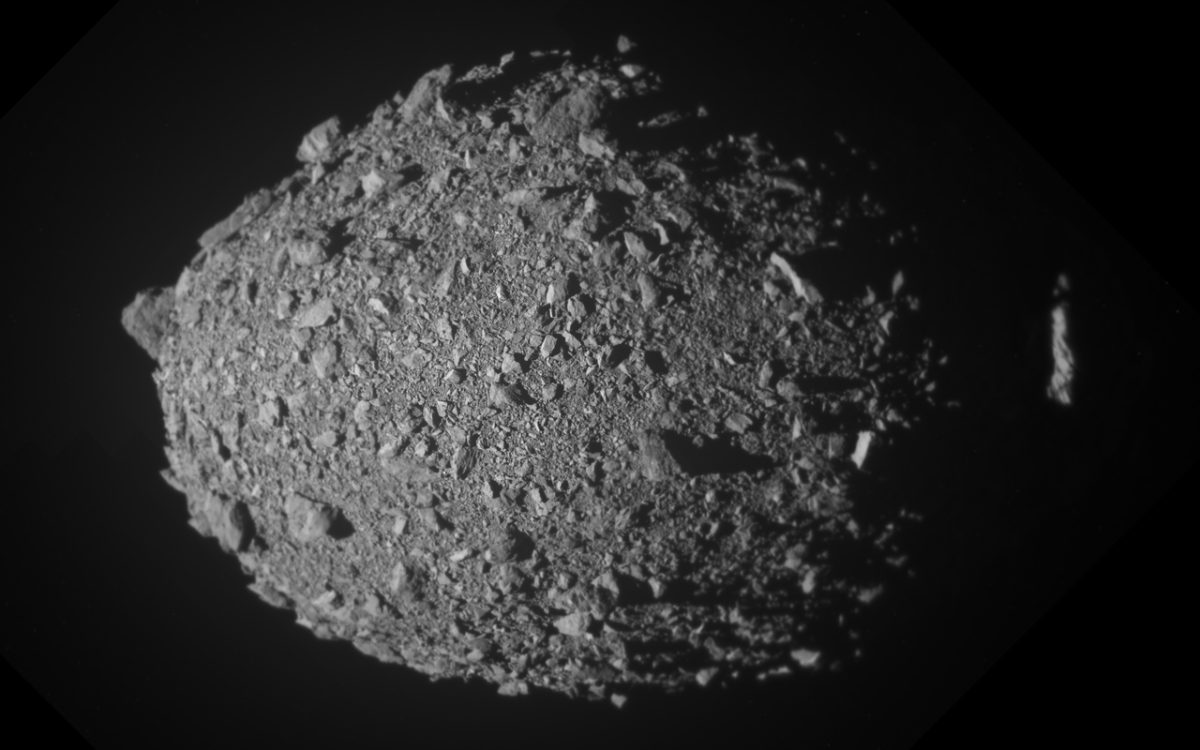
The European Space Agency (ESA) on Wednesday, 25 November 2026, released the first close-up images of the asteroid Dimorphos since NASA deliberately crashed a spacecraft into it in 2022, showing that one face of the small moonlet has been flattened into a crater almost as wide as the body itself — a scar ESA compared to a sports stadium.
The pictures were taken by Hera’s Asteroid Framing Camera on 7 November 2026, from about 29 kilometres away, at a resolution of 2.7 metres per pixel, ESA said in image captions published with the findings. Dimorphos is about 151 metres across and orbits the 730-metre asteroid Didymos at an average distance of about one kilometre. At the time of the observations the pair were some 193.5 million kilometres from Earth.
NASA’s Double Asteroid Redirection Test (Dart) hit Dimorphos on 26 September 2022 at about 22,000 kilometres an hour (the BBC gave the speed as 14,000 mph). The asteroid was not a threat to Earth; the flight was a test of whether a kinetic impact could change a space rock’s path. Telescopes on the ground measured the result: Dimorphos’s orbit around Didymos, which had been 11 hours and 55 minutes, shortened by about 33 minutes, more than had been predicted. A debris trail thousands of kilometres long was visible from Earth and from space. What no one could then see clearly was the crater, or whether the moonlet had changed shape.
“Scientists debated whether Dimorphos had sustained an impact crater, changed its shape or stayed the same,” said Hera principal investigator Patrick Michel, director of research at CNRS / Observatoire de la Côte d’Azur, in ESA’s account. “Much to our surprise the answer turns out to be all three at once! The face struck by Dart has been flattened into an impact crater the size of a sports stadium, which extends across the asteroid’s entire width.” The rest of Dimorphos, ESA said, does not show evidence of major change: boulder fields on other sides look like those in Dart’s 2022 images. Inside the new crater, the agency described unusual structures, including an apparently cigar-shaped feature at the centre.
As more frames arrived it became clear that the impact had also left Dimorphos tumbling in its orbit. “Before the Dart impact, Dimorphos was more like our own Moon — so it was always showing the same face to Didymos, and it was behaving quite nicely,” Dr Sabina Raducan, a planetary scientist on the Hera team, told the BBC. “Now it’s very, very chaotic — it’s tumbling. Imagine a barrel that you throw down the stairs.” Michael Kueppers, ESA’s Hera mission scientist, made the same point in the agency’s release: the moonlet is “tumbling wildly in its orbit.”
Hera has also shown, ESA said, that the two asteroids are surrounded by hundreds of boulders only a few metres across, which the team will have to take into account as the spacecraft moves closer. The small-car-sized probe is in an “early characterisation phase,” flying about 25 to 30 kilometres from the pair in so-called rectangular orbits at an average speed of only about 12 centimetres per second, and using a suite of instruments: the monochrome framing camera, the Hyperscout H imager, which records 25 colours at once, and JAXA’s Thermal Infrared Imager, TIRI, which measures surface temperatures. In the current pictures, the smallest details are about three metres across, the BBC quoted team member Naomi Murdoch as saying — so every boulder visible in the frames is at least that large.
A central scientific goal is to measure Dimorphos’s mass, so that researchers can calculate how efficient Dart’s shove really was. That number would matter if a hazardous asteroid were ever found on a course toward Earth. “It would help us to predict what would happen if we had to hit another asteroid,” Professor Simon Green, also on the Hera science team, told the BBC: planners could then estimate what mass of spacecraft, at what speed and how early, would be needed to nudge a rock off a collision course.
Mission manager Ian Carnelli presented the first images in the dinosaur hall of the Museum für Naturkunde in Berlin, a reminder, ESA said, of why planetary defence is studied: 66 million years ago an asteroid impact changed the course of life on Earth. The work is only beginning. In December the spacecraft is due to approach to about 13 kilometres, returning sharper pictures. In January 2027 Hera plans to deploy two shoebox-sized CubeSats, Juventas and Milani, which will fly still closer. The mission is expected to spend about six months at the Didymos–Dimorphos system.
The photograph published with this article is a file image of Dimorphos taken by Dart itself, moments before the 2022 impact, not one of Hera’s new crater frames; it is credited as such. The new ESA images are the first to show, in close-up, what that collision left behind.
Sources: ESA article and image captions, 25 November 2026, including the 7 November imaging geometry (29 km, 2.7 m per pixel), the 151-metre and 730-metre sizes, quotes from Patrick Michel and Michael Kueppers, the tumbling state, orbiting boulders, the December approach and the January 2027 CubeSats; BBC News, 25 November 2026, quoting Sabina Raducan, Simon Green and Naomi Murdoch, and recalling Dart’s 2022 impact, the 33-minute change in orbit and the debris trail; German Aerospace Center (DLR) caption of the Asteroid Framing Camera image.