Gerhard Richter's permanent Doha Pavilion opens in MIA Park
Qatar Museums unveiled Doha Pavilion: Gerhard Richter on 21 November 2026, a permanent hexagonal structure in MIA Park outside the Museum of Islamic Art. Designed by the German painter with Selldorf Architects, it is clad in tiles based on his Strip patterns and houses three new Strip paintings, two large Mirrors and a Strip Tower.
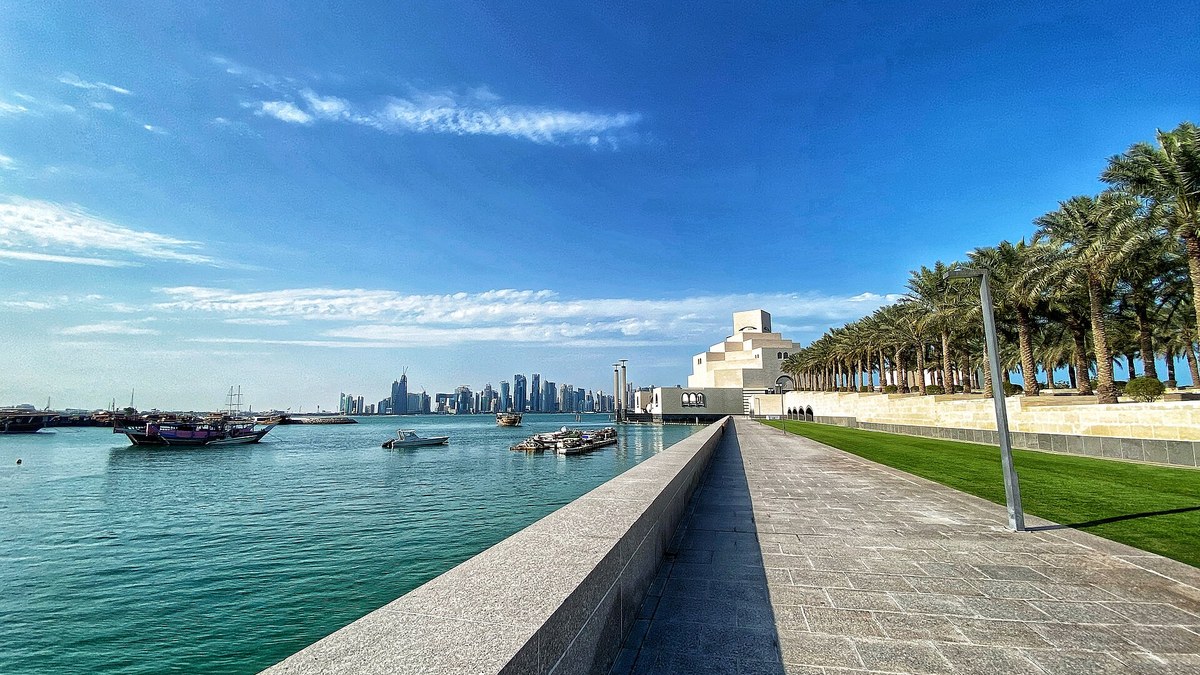
Qatar Museums has opened a permanent pavilion designed by the German painter Gerhard Richter in MIA Park, the large public space outside the Museum of Islamic Art in Doha. Called Doha Pavilion: Gerhard Richter, the hexagonal building was unveiled on Saturday, 21 November 2026. It is conceived as a freestanding work of art and architecture, realised with New York-based Selldorf Architects. It houses a group of Richter's paintings and sculptures, including a new work made for the site, according to The Peninsula and the Qatar Tribune.
Richter, one of the most influential living artists, traced the idea to a visit more than a decade ago. "My trip to Doha in 2013 came two years into developing my Strip paintings, and the city's architecture and history sparked an idea for a pavilion that could unite the thematic threads of that body of work," he said in the Qatar Museums announcement. "Doha is the right place and the only place for my Pavilion."
The design grows out of a precise mathematical process. In 2010 Richter took a digital image of his Abstract Painting (724-4) from 1990 and divided it into two vertical strips. He then split those again and again, into 4, 8, 16 and so on, up to 8,192 strips. Each strip was mirrored and repeated, producing horizontal, symmetrical patterns. Those patterns now cover the pavilion's six exterior walls as decorative tiles. Qatar Museums says both the method and the result echo the carefully built geometry of Islamic art, with its interlaced arabesques and endlessly repeating tiles.
Inside are three new large-scale Strip paintings, part of a series Richter began in 2011. In them the original abstract painting is turned into thin horizontal bands that each represent a slice just 0.08 millimetres wide. At the centre stands a three-part Strip Tower, a freestanding sculpture designed for this space. On the narrow walls hang two floor-to-ceiling Mirrors, from a body of work begun in the 1980s, which reflect both the artworks and the visitors and create a sense of endless space. A stone sculpture titled Brunnen (Well) sits just outside.
"This Pavilion is the profound culmination of many years of his research into abstraction, with intensely physical patterns that invite you to immerse yourself in their endlessness," architect Annabelle Selldorf said. Sheikha Al Mayassa bint Hamad bin Khalifa Al Thani, chairperson of Qatar Museums, said the aim was to make art "part of people's lives". She said the pavilion creates a place to discover connections between contemporary art and the geometric traditions of Islamic visual culture.
The pavilion is a legacy project of the Qatar-Germany 2017 Year of Culture. It joins other major public artworks in MIA Park by artists including Richard Serra, Nairy Baghramian, and Peter Fischli and David Weiss. The setting is significant. The Museum of Islamic Art, designed by I. M. Pei, is one of Doha's best-known buildings. Qatar Museums presents the new pavilion as being in dialogue with it, with the National Museum of Qatar and with the future Art Mill Museum.
For Richter, the project brings together several strands of a career that began in the 1960s and has ranged from photo-based paintings to colour charts, glass works and large abstract canvases. Permanent, purpose-built spaces devoted to a single living artist are rare. Placing one in the Gulf, rather than in Germany, reflects Qatar's long effort to build a world-class collection and use culture as a pillar of its international image. Critics of that strategy point to the country's record on migrant workers' rights, a debate that grew louder around the 2022 World Cup. Supporters argue that free public art in a city park reaches far more people than a gallery would.
The opening is part of Qatar Creates Fall/Winter 2026-27 and coincides with the first edition of Rubaiya Qatar, a new international visual arts quadrennial running from 21 November 2026 to 30 April 2027. The season also includes the second edition of Design Doha, exhibitions, film and public art across the city, according to ILoveQatar.net.
Sources: The Peninsula, 21 November 2026, Qatar Museums announcement with statements by Gerhard Richter, Sheikha Al Mayassa and Annabelle Selldorf; Qatar Tribune, 21 November 2026; ILoveQatar.net, 21 November 2026.