IG Metall 24-hour warning strikes halt Mercedes, BMW and Siemens Gamesa plants
More than 23,400 workers at 19 plants in northern Germany joined 24-hour IG Metall warning strikes on Monday, 23 November 2026, after three failed pay rounds. Production stopped from Sunday night at Mercedes-Benz in Bremen and Hamburg and at Siemens Gamesa in Cuxhaven. In Berlin, the Mercedes-Benz Marienfelde plant and the BMW motorcycle works also halted. The union wants a 5% rise over one year; employers offer a one-off payment and 1.3% from July 2028.
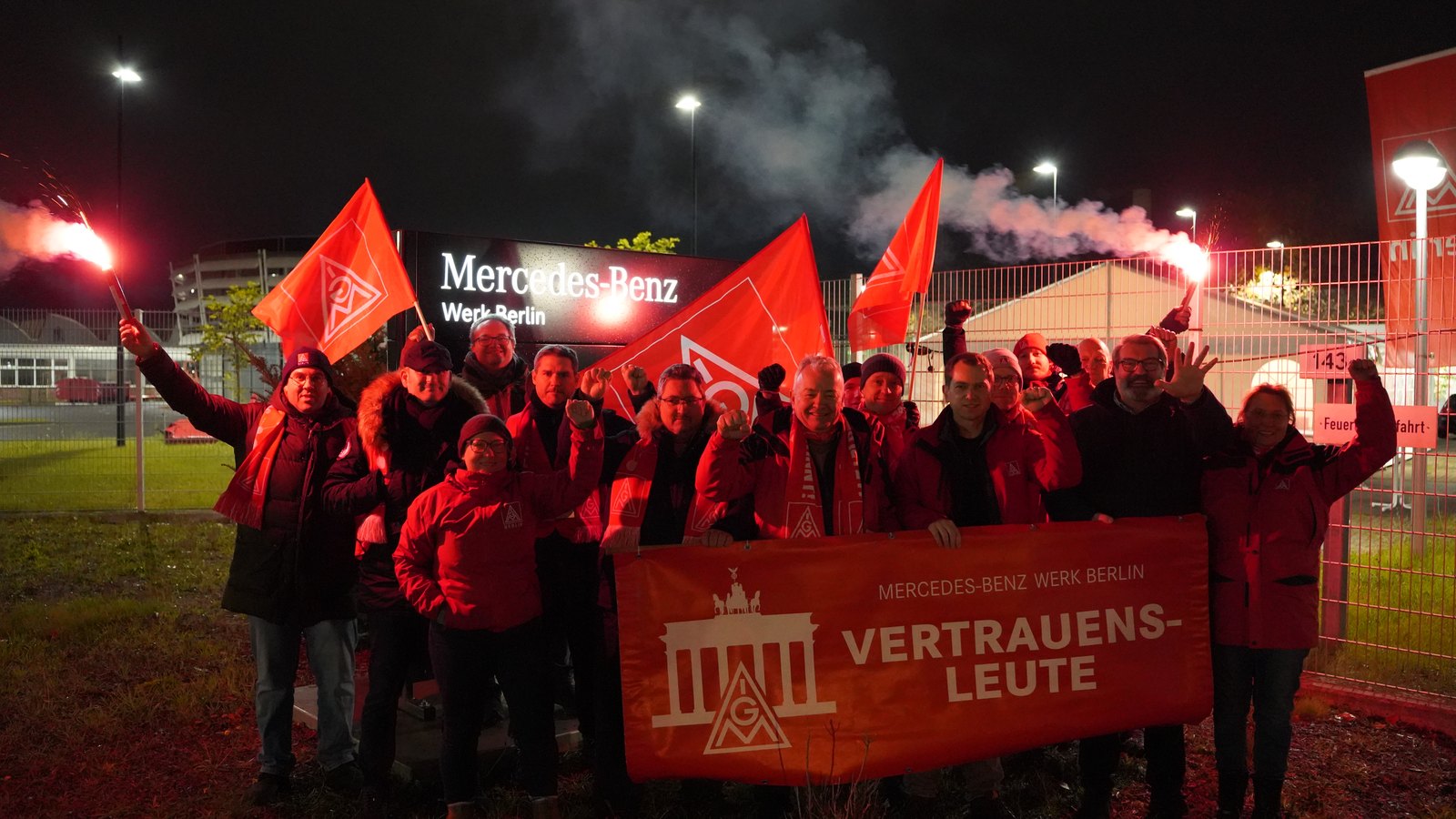
More than 23,400 workers at 19 plants in northern Germany took part in 24-hour warning strikes on Monday, 23 November 2026, IG Metall’s coastal district, IG Metall Küste, said. Production stopped from Sunday night at Mercedes-Benz plants in Bremen and Hamburg and at the Siemens Gamesa wind-turbine factory in Cuxhaven, and the stoppages spread on Monday to further sites, including the Meyer Werft shipyard in Papenburg. In Berlin and Brandenburg, a parallel walkout halted the Mercedes-Benz plant in Marienfelde from 21:00 on Sunday and the BMW motorcycle plant from 06:00 on Monday, the union’s Berlin office said. Mercedes-Benz’s plant in Ludwigsfelde was also affected, Deutschlandfunk reported.
The figures for the north come from an official update published by IG Metall Küste on Monday. Almost 10,700 employees joined the strike at Mercedes-Benz in Bremen and more than 2,000 at the Hamburg plant. Almost 3,600 took part at Meyer Werft in Papenburg, with nearly 500 at the neighbouring supplier KS Gleitlager. The union said the gates also stayed closed at Siemens Gamesa in Cuxhaven, which has 1,370 employees, at Lear Corporation in Bremen, with more than 1,200, and at the crane maker Manitowoc in Wilhelmshaven, with more than 960. A union representative told German public media that the Hamburg Mercedes plant had been idle since 22:00 on Sunday, with only site security inside.
The dispute is the 2026 bargaining round for Germany’s metal and electrical industry, which employs about 3.7 million people. Pay talks are held by district. In the north, Nordmetall negotiates with IG Metall Küste for around 130,000 employees; those talks began on 8 October in Hamburg, the German press agency dpa reported. In Berlin and Brandenburg, the union is bargaining for about 96,000 workers. After three rounds, no deal has been reached in the north or in the other districts. A fourth round has not yet been scheduled on the coast.
IG Metall is seeking a 5% increase in pay and training allowances over 12 months, together with job and site guarantees, a collectively agreed profit-sharing scheme in successful companies and stronger lower pay grades. The employers, coordinated nationally by Gesamtmetall and set out in a Südwestmetall offer of 27 October, have proposed a one-off payment in July 2027 worth 1% of average contractual annual gross pay — about €700 in Baden-Württemberg — and a permanent rise of 1.3% only from July 2028, with a contract running until the end of 2028, a term of 26 months. Companies with a net sales margin below 2.3% could defer or cancel the one-off payment. The union says the package would leave workers worse off after inflation and has called it a “minus offer”. IG Metall chair Christiane Benner, who visited strikers in Cuxhaven, Papenburg and Bremen, said the offer was not enough and that “the pressure really is needed”.
In Berlin, Constantin Borchelt, the union’s first authorised representative and managing director, said at the start of the Marienfelde walkout that after three rounds the employers were still blocking and had “nothing to offer us except real wage losses and attacks on our working conditions”. IG Metall members at the plant had voted unanimously for a full-day warning strike, the Berlin office said. Pickets took over the gates; only emergency services and outside contractors were being let in, with the action due to run into Tuesday night. Daniel Friedrich, district leader and chief negotiator for IG Metall Küste, said the 24-hour strikes were having an effect and that “the plants are at a complete standstill”. It was now for the employers to move and “clear the way for a solution”.
The employers take a different view of the same numbers. Südwestmetall’s leader, Peter S. Krause, already described the planned full-day strikes on 11 November as an “unnecessary escalation” and called on the union to return to the table, arguing that Germany’s metal and electrical industry is in its deepest structural crisis in decades and needs lower costs if firms are to keep investing at home. Mercedes-Benz confirmed to Euronews that its plants were affected and that it was adjusting operations, and said it fully supported the Südwestmetall statement. The carmaker did not give details of the impact on output. German public media have previously quoted employers describing earlier warning strikes as “irresponsible and disproportionate”.
The clash comes as the car industry, the core of the metal sector, is under heavy strain. Gesamtmetall says 350,000 metal and electrical jobs have been lost in Germany since the 2019 peak, almost 100,000 of them in Baden-Württemberg, and that many companies expect further cuts. Euronews, citing Handelsblatt and SWR, reported that Mercedes-Benz is seeking €800 million in annual savings in Germany and has discussed longer hours without extra pay, cuts to benefits and a suspension of investment at home. BMW had previously sought to cut nearly 8,000 jobs through voluntary departures, according to Münchner Merkur, as cited by Euronews. Volkswagen, which owns Audi, is in separate talks with IG Metall covering about 120,000 employees and has sought a two-year pay freeze and more flexible hours, Reuters reported. The union’s answer is that real wages and job security must be defended if domestic demand and the industrial base are to hold.
Monday’s action follows shorter and then full-day warning strikes after the peace obligation ended on 31 October, the first 24-hour warning strikes in the sector for eight years, according to SWR. IG Metall told Euronews that 151,000 workers took part in nationwide walkouts on Friday; Deutschlandfunk put the figure at more than 150,000. In the north alone, IG Metall Küste said more than 35,000 employees in 36 plants had already downed tools for 24 hours since Friday. SWR reported that full-day strikes were also called at 45 plants in Baden-Württemberg on Monday, including Mercedes-Benz in Sindelfingen, Porsche in Stuttgart-Zuffenhausen and Daimler Truck in Mannheim.
What comes next is already mapped out in the north and the south-west. On Tuesday, IG Metall Küste will widen the 24-hour strikes to 22 plants and almost 40,000 workers, with the focus on Airbus sites in Hamburg, Bremen, Stade, Nordenham and Varel, where almost 34,000 employees have been called out, as well as Liebherr in Rostock, Ariane Group in Bremen and Flowserve in Itzehoe. Friedrich said the Tuesday action would be the high point so far of the full-day stoppages on the coast, and that the pressure was needed if employers were to move in the next round. A first effect, the union said, is already visible: talks are due to resume on Wednesday in Baden-Württemberg, a possible pilot district. In the Küste district itself, no further negotiation has been scheduled.
Sources: IG Metall Küste, 23 November 2026; IG Metall Berlin, 23 November 2026; Deutschlandfunk, 23 November 2026; Euronews, 23 November 2026; Tagesschau, 23 November 2026; Südwestmetall, 11 November 2026; Südwestmetall offer, 27 October 2026; SWR, 23 November 2026.