EU and Indonesia sign landmark trade and investment deal after a decade of talks
The EU and Indonesia signed a Comprehensive Economic Partnership Agreement and an Investment Protection Agreement in Brussels on 21 November 2026, ending almost a decade of talks. The Commission says the deal removes 98.5% of tariffs and saves EU exporters about €650 million a year, while 90.4% of Indonesian tariff lines enter the EU duty-free from day one.
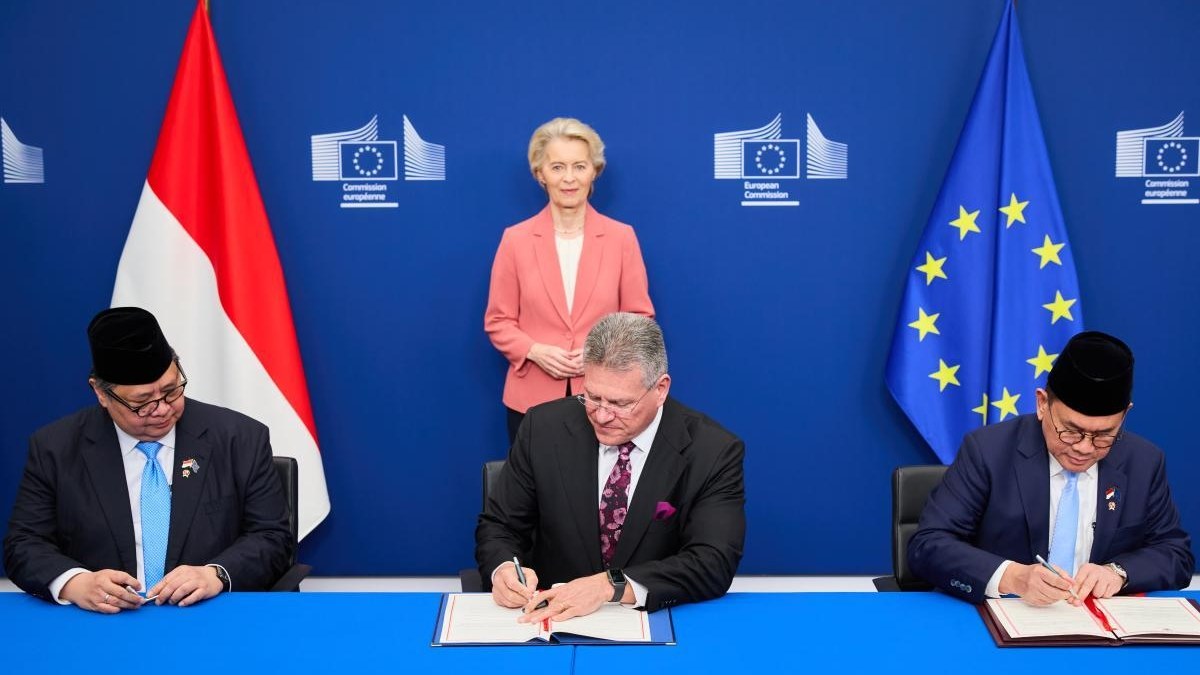
The European Union and Indonesia signed a Comprehensive Economic Partnership Agreement (CEPA) and a separate Investment Protection Agreement in Brussels on Saturday, 21 November 2026. The signing closes almost ten years of negotiations. It also gives the EU one of its most important trade deals in Asia. At the Commission's headquarters, EU trade commissioner Maroš Šefčovič signed the texts with Indonesia's coordinating minister for economic affairs Airlangga Hartarto, trade minister Budi Santoso and investment minister Rosan Perkasa Roeslani. Commission President Ursula von der Leyen looked on, according to the Commission's audiovisual service. "This is one of the most ambitious deals the European Union has concluded in Asia," von der Leyen said, as quoted by CNA.
The numbers are large. According to the European Commission, the agreement removes 98.5% of tariffs and should save EU exporters about €650 million a year in duties. It opens a market of 280 million consumers. Indonesian tariffs of up to 50% on cars, 15% on machinery, 25% on chemicals and 15% on pharmaceuticals will be cut. Brussels projects that EU exports to Indonesia will rise by almost 40% within 15 years. It also expects the EU's GDP to be €16 billion higher, and Indonesia's €27 billion higher, by 2042 than without the deal, CNA reported. "Together, we represent a market of 730 million people," von der Leyen said.
For Jakarta, the main gains are in labour-intensive exports. Hartarto said 90.4% of Indonesian tariff lines will enter the EU duty-free from the first day. Another 8.37% will be phased out over three to 15 years or handled through tariff-rate quotas, according to ANTARA. Palm oil and its derivatives, garments, textiles, footwear and fisheries products are among the first to benefit. "The benefits for our exporters are concrete and measurable," Hartarto said, calling the agreement a "new chapter" in relations with Indonesia's largest trading partners in Europe.
European farmers also get new openings. EU agri-food exports to Indonesia were already worth €960 million in 2025. The deal removes tariffs on processed foods, most dairy products including cheese and infant formula, and poultry and beef products. It also protects 221 EU geographical indications, such as Roquefort cheese and Kalamata olive oil. Sensitive EU sectors are protected: there is no new access for rice, sugar, eggs, fresh bananas or ethanol, and only limited quotas for products such as garlic, mushrooms and sweetcorn.
Raw materials are at the strategic heart of the agreement. Indonesia is the world's leading producer of nickel and a major source of cobalt, both vital for electric-vehicle batteries and other green technologies. The Commission says the CEPA gives EU manufacturers more stable and predictable access to these materials. That matters at a time when Europe is trying to reduce its dependence on China for critical supply chains. The text includes a commitment to environmental impact assessments for mining projects. Indonesia, for its part, wants European investment and technology in nickel processing, EVs, renewables and electronics.
Palm oil was for years the main obstacle. The EU's deforestation rules and earlier restrictions on palm-based biofuels angered Jakarta. The final package includes a dedicated Protocol on Palm Oil to promote sustainable trade, and a duty-free export quota for crude palm and palm kernel oil. It also has enforceable commitments on the Paris climate agreement and core labour standards, and a role for civil society in monitoring implementation. Environmental groups will watch closely how these chapters are applied in practice.
The deal fits a wider EU strategy. Faced with US tariffs and tensions with China, Brussels has sped up trade agreements across the Indo-Pacific and Latin America. In Southeast Asia it already has agreements with Singapore and Vietnam. Negotiations with Thailand are ongoing, and a substantial agreement with the Philippines was announced in October 2026, the Commission notes. Negotiations with Indonesia were launched in July 2016 and concluded in September 2025.
Signing is not the final step. The European Parliament must give its consent, and Indonesia must complete ratification, before the agreement can provisionally apply. Hartarto said Jakarta was aiming for January 2027. Von der Leyen said President Prabowo Subianto will visit Brussels on 11 December, before both leaders travel to the G20 summit in Miami.
Sources: European Commission, The EU-Indonesia trade agreement (page reviewed 21 November 2026); CNA / AFP, 21 November 2026; ANTARA, 21 November 2026; European Commission Audiovisual Service, signing ceremony, 21 November 2026.